Smart, Safe, or Fast: Every conversation AI assistant picks two
For the last three years I’ve spent most of my time building AI systems across different domains. Some never made it past the MVP phase; some now handle dozens of messages per minute. But on every single project, I kept running into the same trade-off between Smart, Safe, and Fast properties, which I’ll refer to as Capability, Control, and Latency. This post is my attempt to crystallize that idea.
The inspiration is the CAP theorem from distributed systems. It states that any distributed data store can provide at most two of three guarantees: Consistency, Availability, and Partition tolerance. Because network partitions are inevitable in real-world systems, engineers must effectively choose between Consistency and Availability. I’ve framed conversational AI trade-offs in the same shape, with one caveat: mine is an empirical pattern rather than a formal theorem like CAP.
The three properties
Every conversational system wants all three:
Capability (smart). Reasoning depth, RAG retrieval, tool use, more agent steps.
Control (safe). Input and output guardrails are mandatory in any production conversational AI system. You can minimize the latency impact of input guardrails by running them in parallel with the main logic and short-circuiting on failure, but output guardrails add directly to overall latency.
Latency (fast). Time to first token, time to full response. Streaming helps perceived latency, but every extra agent step, retrieval call, or output check pushes the floor up.
Most, if not all, conversational AI systems have a maximum latency constraint, because latency is a fundamental user-experience property of a conversational interface.
Just as partition tolerance is effectively non-negotiable in CAP, latency is non-negotiable in chat. So in practice, you’re choosing between Capability and Control.
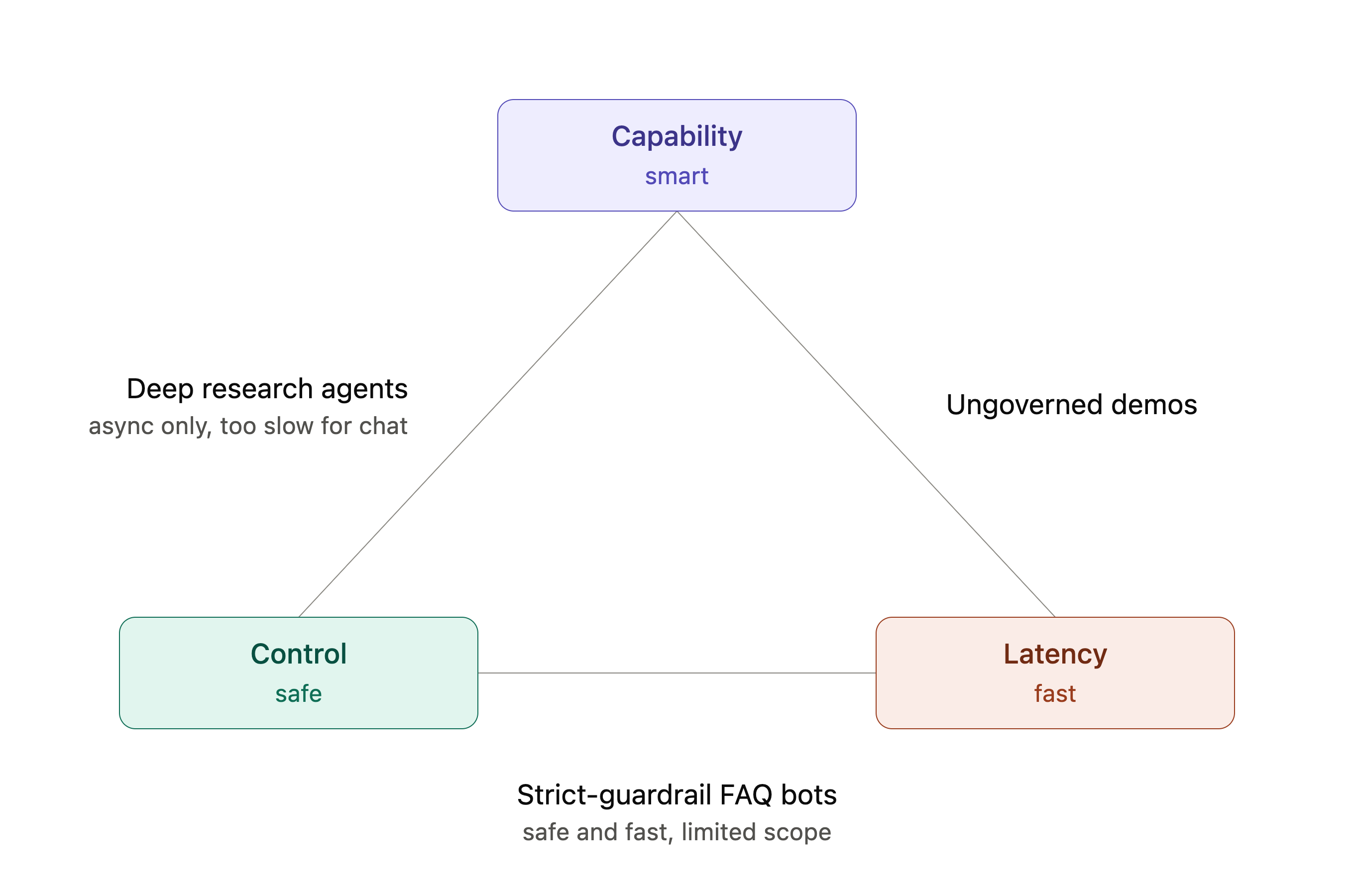
The three trade-offs
Capability + Latency, sacrificing Control. A state-of-the-art model streaming replies straight to the user with no guardrails or groundedness checks. This is the naive POC everyone builds first, but it won’t survive past the POC stage in most domains, and can’t reliably run in production.
Control + Latency, sacrificing Capability. A cheaper, faster model behind strict guardrails. It answers quickly and safely, and it responds to most user questions with an “I can help you with billing, appointments, or FAQs!” fallback. This can be a reasonable choice, especially in heavily regulated use cases, but it’s very limited in functionality and delivers a poor experience whenever user expectations doesn’t match what the system supports.
Capability + Control, sacrificing Latency. Deep research agents and heavyweight verification pipelines. Fine for async work; won’t work for chat. This is the escape hatch: when a task truly needs both intelligence and safety, you make it asynchronous.
The future
CAP is a theorem that has been with us for a long time and has never been fully “solved.” Capability, Control, and Latency behave differently: they shift almost every month, with smarter models, new techniques, new inference chips and who knows what else. Maybe this post will be outdated within six months, though I doubt it.
In conversational AI, the ultimate constraint remains the human on the other end. In the era of fast internet, people simply aren’t used to waiting more than ten seconds for a reply. So decide deliberately which corner you’re giving up. In my experience, the teams that struggle most are the ones that drifted into a trade-off without ever noticing they were making one.